The McGahern children’s lives under their father’s tyranny
The Greatest Beer Run Ever: A Memoir of Friendship, Loyalty, and WarThe McGahern children’s lives under their father’s tyranny were governed by the threat of sudden punishment and by a household in which care could be made to feel like debt. After Susan McGahern’s death, the children had to endure their father’s rages with little protection. Their answer was gradual and collective: they learned his moods, warned one another, and gathered around whoever had been beaten. This solidarity could not stop his worst violence, but it changed the children from isolated targets into a band capable of supporting and, in private, mocking the authority that ruled them.
A household turned against its children
In the years immediately after Susan McGahern’s death, the family was in disarray. The children faced sudden rages, beatings, punishments, and constant scolding without the defence their mother had provided. Their father, Francis (Frank) McGahern, repeatedly lamented the burden of having so many children and threatened to put them in a bag, send them out beneath Cootehall Bridge, or pack them off to an orphanage. These threats recurred alongside the Rosary, making religious devotion and paternal menace part of the same household soundscape.
The pressure was not confined to the moments of physical punishment. At the end of each month, their father lined the children up and read aloud from a small notebook, covered in blue cloth from an old police uniform, everything they had eaten on credit at Henry’s. If the total was higher than usual, he questioned them about costly items such as butter and could order them to eat dry bread once the household had used four pounds. The public accounting turned food into evidence against them: the children were made to feel both burdensome and ashamed for needing what a family had to eat.
Clothing and shoes carried a different but equally controlling routine. The children changed into old clothes as soon as they returned from Mass, and the girls became skilled at sewing, knitting, and darning. On some nights their father searched for hidden boots, hauled everyone out of bed, and arranged the footwear in a row in the living room. He repaired selected pairs in his brown apron, sometimes continuing until grey morning. The child whose boots were being fixed had to stay awake to pass tacks and hold the waxed thread, and might be struck for handing over the wrong nail or dropping something. The others were beaten and sent back to bed. A practical task became a prolonged night of fear and exhaustion.
Learning to survive together
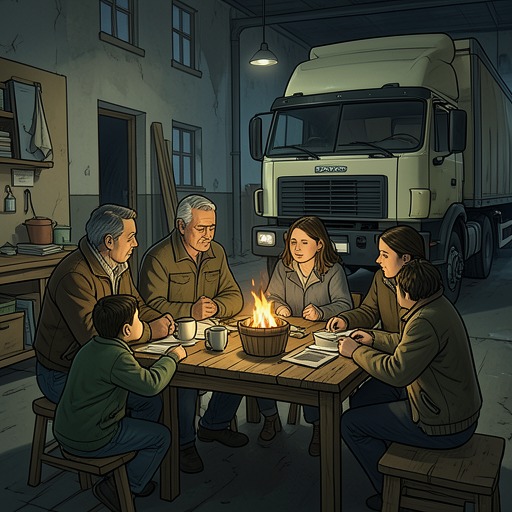
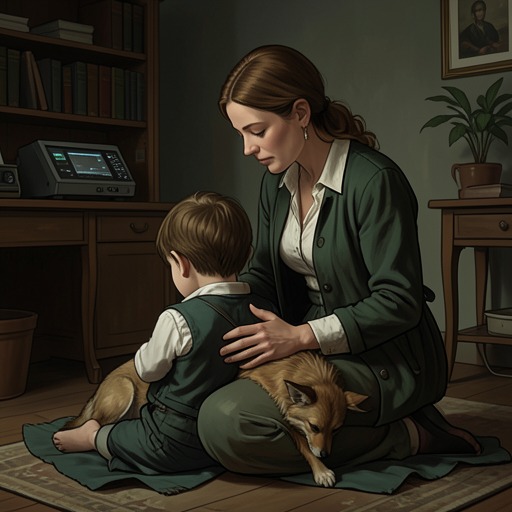
The children gradually developed a shared defence. Close in age, they suppressed ordinary rivalries because they could not afford to divide themselves. A child who complained to their father about a sibling, or tried to win his favour at another’s expense, risked being ostracized. After a beating, the others gathered around the one who had been hurt, comforting them and affirming the unfairness of what had happened. Their response did not undo the punishment, but it eased their misery and strengthened their anger against it.
They also learned to anticipate danger. By reading their father’s moods, they could send warnings in an instant, vanish from his reach, or adopt the appearance of abject misery. These tactics arose instinctively and became more practised over time. They could soften an attack without reliably preventing its worst excesses. Just as important, the children did not let their father’s good moods erase their knowledge of what might follow. His charm could make them more vulnerable to the next outburst; the siblings’ growing mistrust helped keep them from mistaking a temporary lull for safety.
The new solidarity took time to form. In its private expression, it became comic performance. When the children felt safe enough, they staged impromptu concerts in which they imitated their father’s repeated complaints and threats. Monica played an imaginary piano; Rosaleen took up the imagined drums. They recast the threats about the orphanage, the bag, and the bridge as material for a family performance. In the children’s own description, “We were mastering our master.” The phrase names a limited victory: they could not take away their father’s power to punish them, but they could repeat his words on their own terms and make his authority an object of ridicule.
Their play remained cautious. On one occasion their father entered while they were performing. The children did not think he could admit what he had seen and heard, but for a time afterwards they posted a sentry before playing; eventually they again broke into sudden performance, especially when he was away. Breedge adored her father but understood the consequences of siding openly with him, so she did not join in. The youngest children were too young to take part. The unevenness of the performance shows both the reach of the family bond and the limits imposed on it by age, affection, and fear.
Trauma, caregiving, and its limits
The violence also appeared in the children’s bodies and sleep. Several began walking in their sleep after their mother died. The narrator woke in the shallows beside the Tarred Boat on one occasion and on the stairs on another. Rosaleen’s sleepwalking was more severe: she moved throughout the house at night and entered the dayroom, startling the barrack orderly in his bed. Her father beat and warned her, but the punishment made the problem worse. Rosaleen later understood the episodes as a delayed response both to their mother’s death and to the brutality of the household.
Their father eventually sent for Dr Vesey. Rosaleen was diagnosed as suffering trauma and taken to Roscommon Hospital, where she was ordered to rest completely. She spent two months there. After this, her father never beat her physically again, although he continued to scold her at every turn. The change in his conduct did not remove the household’s emotional pressure, but Rosaleen stopped sleepwalking. She was regarded as particularly intelligent and sensitive, and the continuing scolding weighed heavily on her.
Katie McManus, who kept house and cared for the baby, had in some measure taken over Susan McGahern’s effort to protect the children. She moved them out of their father’s way, sometimes scolded them herself to divert his attention, comforted them, and let her disapproval show. Her position was precarious. Going into the village most nights increased her father’s resentment, and her connection with Peter McLoughlin appears to have intensified it. Her return to the household came only after a succession of unsatisfactory maids and mounting disorder forced their father to accept arrangements made by Maggie.
The return brought practical improvements, not a transfer of authority. The living room became cleaner and more orderly; the small range was kept alight, meals became more regular, and the children had clean changes of clothes. Katie had full charge of Dympna and Frankie, but was not to interfere with their father’s authority over the other children. She still comforted them privately after beatings, yet no longer tried to shield them during his rages, instead turning to her tasks or leaving the room. She went out to Gilligan’s, where there was music and dancing and Peter was often with her; he no longer came near the barracks. When Katie and Peter later left for England, Katie’s stay had lasted close to two years. The narrator remembered her kindly, but her presence also marked a growing division between the younger children in her care and the older siblings.
Inherited beliefs and the cost of endurance
The children’s dependence on one another formed against a wider absence of protection. Their father’s resentment seemed to grow regardless of their conduct, and years of hearing that he had sacrificed for them shaped what the narrator believed about their obligations. Some years later, the narrator sincerely told a priest who knew the family that the children owed their father a great debt for raising them. The priest rejected that account: the children had not asked to be born, and their father had taken on responsibility for them by bringing them into the world. The narrator did not repeat the priest’s answer to his father, but it changed how he understood the family. The old claim of debt began to look less like an objective measure of sacrifice than a belief imposed through repetition.
Susan McGahern’s death had also removed a central source of care and communication. Her faith may have sustained her, but her husband used religion against her by accusing her of losing faith in God. The narrator recalled her pain at losing those who depended on her and loved her, and the loneliness of having no one with whom to communicate it after her forty-two years among people who loved her. Before her death, the narrator sought time alone with her after school, telling her the school news and returning after chores such as gathering sticks or feeding the ailing white bullock. The Rosary came to be said in her bedroom, with Katie bringing the narrator’s brother upstairs to kneel around the bed. The children’s later mutual care developed in the space left by this intimate family centre, but it could not reproduce the protection their mother had offered.
The state of the household was therefore neither uninterrupted helplessness nor a simple escape through sibling affection. The children learned to comfort the beaten, anticipate danger, and reclaim their father’s threats as comedy; Katie brought routine and private kindness, while Rosaleen’s hospital stay coincided with the end of physical beatings directed at her. Yet their father retained authority, Katie’s protection was restricted, and the children’s strategies could only make his violence more bearable. Their gradual gathering into a single band is the decisive change: resistance begins not with the end of the tyranny, but with the children’s refusal to face it alone.